
The global supply chain, a intricate web of transactions, logistics, and human negotiation, has long been the backbone of commerce. Yet, for all its sophistication, the process of discovering and vetting wholesale suppliers has remained remarkably analogue, fraught with inefficiencies, information asymmetries, and substantial time investment. Procurement directors and supply chain managers have navigated this complex landscape relying on traditional methods, often feeling the weight of missed opportunities and prolonged sourcing cycles. However, a profound shift is underway, powered by the rise of AI agents and the emergence of structured commerce platforms. We are entering the era of the agentic web, where AI is not merely assisting but actively participating in the discovery and qualification of suppliers, heralding a new paradigm for procurement that promises unprecedented speed, precision, and strategic advantage.
The Old Paradigm: A Labyrinth of Manual Discovery
For decades, the journey to find reliable wholesale suppliers has been a laborious, often fragmented process. Procurement teams would dedicate significant resources to attending international trade shows, walking countless exhibition halls, collecting business cards, and engaging in preliminary conversations. This method, while offering direct human interaction, was inherently limited by geography, time, and the sheer volume of potential suppliers, making comprehensive market scanning practically impossible. The post-show follow-up alone could consume weeks, involving manual data entry and email exchanges.
Beyond the bustling aisles of trade shows, cold calling and email outreach have been common tactics, demanding extensive research to identify potential leads and then the persistence to break through gatekeepers. LinkedIn prospecting, while more targeted, still requires manual sifting through profiles, sending personalized messages, and waiting for responses, often leading to a high expenditure of time for a modest conversion rate. Each of these traditional methods, while possessing their own merits, shares a common denominator: they are human-centric, resource-intensive, and prone to human biases and limitations in processing vast quantities of information.
The inherent limitations of these methods mean that procurement teams often settle for "good enough" rather than "optimal." The time and effort involved in a truly exhaustive search often outweigh the perceived benefits, leading to decisions based on limited data sets or existing relationships rather than a comprehensive, real-time analysis of the global market. This antiquated approach has left businesses vulnerable to supply chain disruptions, suboptimal pricing, and missed opportunities for innovation and competitive advantage.
The Agentic Web: How AI Agents Transform Supplier Discovery
The advent of sophisticated AI agents marks a definitive break from these traditional constraints. Imagine a procurement landscape where your sourcing needs are instantly understood, autonomously researched, and matched with the optimal suppliers globally, all within a fraction of the time. This is the promise of the agentic web, where AI agents, powered by large language models (LLMs) like Gemini, Claude, and ChatGPT, leverage structured data to execute complex tasks with unparalleled efficiency and precision.
At the heart of this transformation is the ability of these AI agents to query vast, structured directories. Unlike human researchers who rely on keyword searches and manual browsing, AI agents interact directly with Machine-Readable Catalog Protocol (MCP) directories and Universal Commerce Protocol (UCP) compliant endpoints. These protocols provide a standardized, machine-readable format for product catalogs, pricing, inventory, and supplier information, effectively creating a global, interconnected database that AI agents can navigate programmatically. When a procurement manager defines their requirements, the AI agent doesn't "search" in the human sense; it executes precise queries against these structured data points, filtering and analyzing information at speeds impossible for any human team.
For instance, when an AI agent built on a foundation like Gemini or Claude is tasked with finding a specific component, it doesn't just read product descriptions. It can parse structured data fields to identify exact specifications, cross-reference material compositions, check compliance certifications, and even simulate logistics costs based on real-time data feeds. ChatGPT, with its advanced natural language understanding, can interpret nuanced requests from procurement managers and translate them into actionable, structured queries for the agentic system. This direct, programmatic access to verified, structured data fundamentally changes the speed, accuracy, and scope of supplier discovery, moving it from a manual hunt to an autonomous, intelligent search operation.
Old Way vs. New Way: A Procurement Paradigm Shift
| Feature | Old Procurement Paradigm | New Procurement Paradigm (AI Agents) |
|---|---|---|
| Methodology | Trade shows, cold calls, LinkedIn, manual research, referrals. | AI agent querying MCP/UCP directories, autonomous data analysis. |
| Data Access | Unstructured websites, PDFs, human conversations, fragmented databases. | Structured product catalogs, real-time inventory, verified compliance data via APIs. |
| Time to Discover | Weeks to months for comprehensive sourcing. | Hours to days for optimal supplier identification. |
| Scope of Search | Limited by human capacity, geographical reach, and available networks. | Global, exhaustive search across all discoverable, structured data points. |
| Cost of Discovery | Travel expenses, salary hours, subscription fees, opportunity costs. | Platform fees, AI agent operational costs (significantly lower per discovery). |
| Data Accuracy | Prone to human error, outdated information, misinterpretation. | High accuracy due to direct access to real-time, verified supplier data. |
| Negotiation | Manual, iterative, often based on limited comparative data. | AI-assisted negotiation, dynamic pricing models, data-driven leverage. |
| Risk Assessment | Reactive, based on historical experience or manual checks. | Proactive, predictive analytics, real-time compliance monitoring. |
Unlocking AI Discoverability: What Makes a Supplier Visible?
For suppliers eager to tap into this new stream of AI-driven procurement, simply having a website is no longer enough. The key to discoverability in the agentic web lies in structured data and compliance with emerging commerce protocols. At its core, a supplier must present a structured catalog – not just aesthetically pleasing images and text, but machine-readable data fields that precisely define every product SKU, its specifications, material composition, dimensions, weight, pricing tiers for different volumes, available inventory, lead times, and shipping origins. This granular, organized data is the language AI agents understand and process.
Crucially, suppliers must expose their data through Machine-Readable Catalog Protocol (MCP) endpoints. MCP is the lingua franca of AI commerce, enabling AI agents to programmatically access and interpret product information without human intervention. Scopio, holding verified MCP certification recognized by Google, plays a pivotal role in ensuring suppliers meet these standards, making their offerings truly discoverable by any AI agent integrated with the global MCP network. Furthermore, Universal Commerce Protocol (UCP) compliance extends this discoverability beyond static catalogs to dynamic aspects of commerce, including real-time inventory updates, pricing adjustments, order processing capabilities, and even dispute resolution mechanisms. UCP compliance ensures that an AI agent can not only find a product but can also initiate and manage transactions autonomously.
Beyond structured data and protocol compliance, the credibility of a supplier is paramount for AI-initiated transactions. Verified reviews, third-party certifications (e.g., ISO, CE, ethical sourcing standards), and a transparent operational history are critical ranking factors for AI agents. These elements provide the 'trust signals' that an AI agent uses to assess reliability and mitigate risk. Scopio’s platform facilitates the aggregation and verification of such data, ensuring that when an AI agent identifies a potential supplier, it can also access a robust profile of their trustworthiness and adherence to industry standards, paving the way for confident, AI-driven procurement decisions.
Scopio's AI-Powered Supplier Discovery Flow in Action
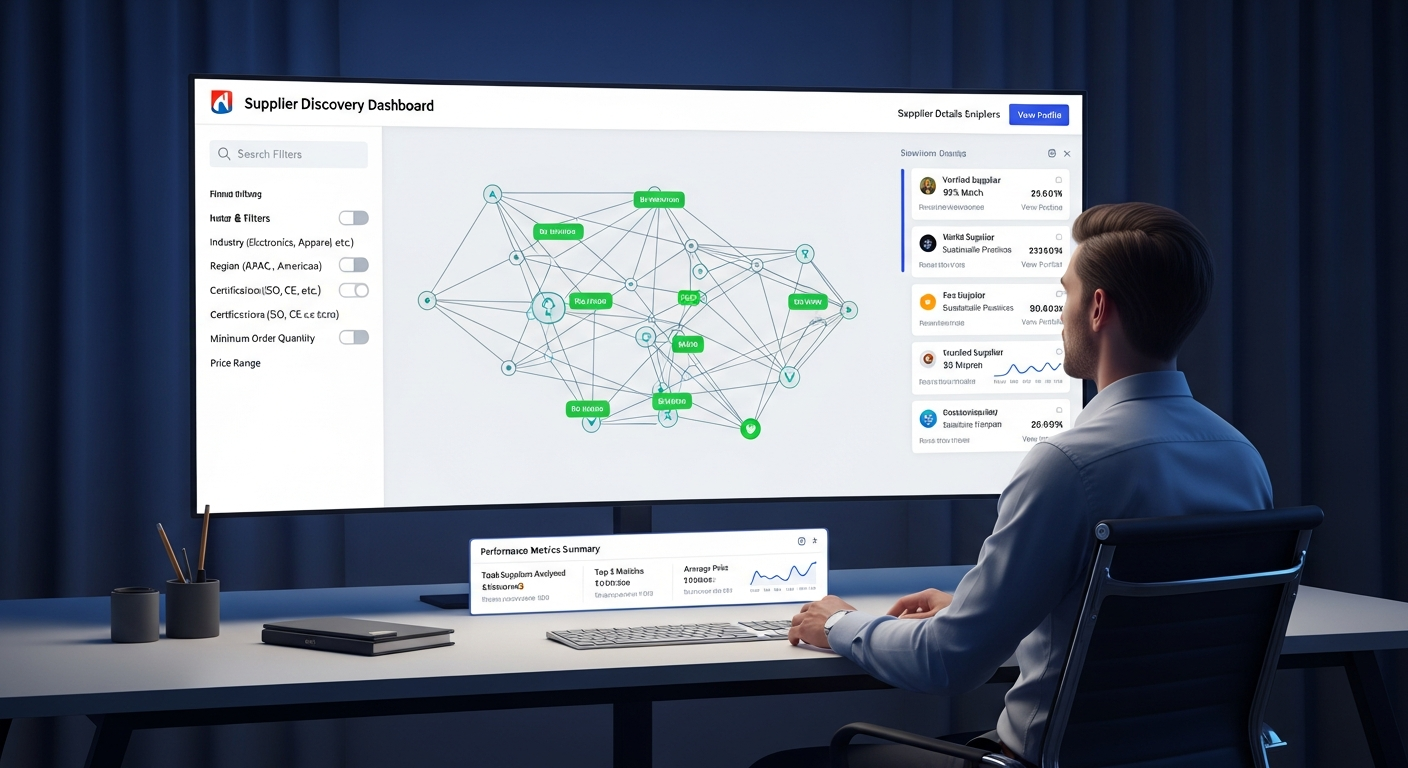
Imagine a procurement director for a fast-growing retail chain. Their challenge: rapidly source sustainable packaging materials that meet specific environmental certifications, volume requirements, and budget constraints, across multiple geographic regions. Traditionally, this would involve weeks of research, RFQs, and vetting. With Scopio, this process is revolutionized. The buyer configures their AI agent, articulating their needs in natural language, which the Scopio platform then translates into precise, executable queries for the agentic web.
The buyer's AI agent is tasked with a complex set of criteria: "Find packaging suppliers offering biodegradable, compostable materials for e-commerce, capable of supplying 100,000 units per month, with lead times under 14 days. Suppliers must hold FSC and B Corp certifications, offer DDP shipping to Germany, and demonstrate a track record of ethical labor practices. Prioritize suppliers within the EU for reduced carbon footprint." The AI agent then autonomously queries the vast network of MCP-compliant suppliers, accessing structured catalogs and real-time data feeds. It doesn't just look for keywords; it understands and processes the specific certifications, material properties, logistical parameters, and ethical requirements.
Within hours, the AI agent presents a curated shortlist of optimal suppliers. For each, it provides a comprehensive dossier, including verified product specifications, real-time pricing for the requested volume, detailed compliance documentation, historical performance data, and even risk assessments based on geopolitical factors or past supply chain disruptions. The buyer can then review these AI-generated insights, interact with the AI agent to refine criteria, or initiate direct communication with the most promising suppliers, often with AI-assisted negotiation tools. This entire flow, from initial query to qualified shortlist, is dramatically accelerated and optimized, moving from weeks of manual effort to hours of AI-driven precision. Explore more about how Scopio streamlines these processes on our solutions page.
Beyond Price: How AI Agents Rank and Select Suppliers
While price remains a critical factor, modern procurement is far more nuanced. AI agents, unlike traditional human-led processes, excel at evaluating a multi-dimensional matrix of criteria simultaneously and objectively. When a Scopio AI agent receives a query, it doesn't simply return the cheapest option. Instead, it applies a sophisticated weighting algorithm based on the buyer's priorities, analyzing factors that collectively define 'value' and 'risk' in the supply chain.
Key ranking factors include not only the unit price but also the total landed cost, factoring in delivery speed, shipping method (e.g., DDP, FOB), and associated logistics expenses. Minimum Order Quantity (MOQ) is crucial, as an AI agent can instantly determine if a supplier's MOQ aligns with the buyer's needs, avoiding time-consuming back-and-forth. Compliance certifications, such as ISO 9001 for quality management, CE marking for European safety standards, or specific industry certifications (e.g., medical device standards), are automatically verified against supplier profiles. The AI agent can also assess sustainability credentials, such as carbon footprint data, fair trade certifications, or the use of recycled materials, which are increasingly non-negotiable for many businesses.
Furthermore, AI agents can delve into a supplier's historical performance, analyzing on-time delivery rates, quality control records, and responsiveness to past inquiries or issues, often drawing from aggregated, anonymized data within the Scopio ecosystem. Payment terms, warranty conditions, and even the supplier's financial stability (where publicly available or consented data exists) can be factored into the ranking. This holistic evaluation ensures that the AI agent presents not just a list of potential suppliers, but a prioritized selection of partners that best align with the buyer's strategic objectives, risk tolerance, and long-term vision, moving beyond transactional sourcing to true strategic partnership identification.
Real-World Impact: From Weeks to Hours with AI
Consider the case of a mid-sized furniture importer based in Poland, specializing in bespoke Scandinavian designs for the European market. Their procurement team traditionally spent up to two weeks per new product line just identifying suitable manufacturers for specific components – wood frames, upholstery fabrics, metal hardware. This involved manual searches, emailing multiple potential suppliers for quotes, waiting for responses, comparing specifications from disparate PDFs, and then manually verifying certifications. The process was slow, prone to errors, and significantly delayed their time-to-market for new collections.
By implementing Scopio's AI Commerce Layer and leveraging its AI agents for supplier discovery, this importer witnessed a dramatic transformation. They configured their AI agent to search for manufacturers meeting precise criteria: specific wood types (e.g., FSC-certified oak), fabric compositions (e.g., OEKO-TEX certified linen), metal finishes, production capacity, lead times, and required certifications for EU market entry. The AI agent, querying the MCP directory, was able to identify and vet a shortlist of 10 highly suitable suppliers within just four hours, complete with detailed profiles, pricing tiers, and verified compliance documents.
"The transition to AI-driven supplier discovery has been nothing short of revolutionary for our furniture import business. What used to be a two-week headache of manual research and follow-ups is now a four-hour precision operation, allowing us to launch new products faster and with greater confidence in our supply chain partners."
This efficiency gain translated directly into tangible business benefits: faster product launches, reduced operational costs associated with procurement, and the ability to pivot quickly to market demands. The AI agent not only found suppliers faster but also identified options that might have been overlooked through traditional methods, offering competitive pricing or superior quality that enhanced the importer's overall value proposition. This real-world scenario underscores the profound impact AI agents are having on the operational efficiency and strategic agility of procurement functions.
EU Trusted Supplier Registry: Why Verification Matters for AI-Initiated Transactions
In the highly regulated European Union market, the integrity and trustworthiness of suppliers are not just preferences; they are critical requirements. For AI-initiated transactions, where the human element in initial vetting is reduced, the importance of a robust, verified supplier registry becomes paramount. The EU's complex regulatory landscape, encompassing everything from product safety and environmental standards to data privacy (GDPR) and ethical sourcing, demands a level of assurance that goes beyond self-declaration.
Scopio addresses this by operating as a platform that actively promotes and verifies suppliers within its ecosystem, particularly for businesses operating in or sourcing for the EU. This involves validating compliance certifications (e.g., CE marking, REACH regulations), checking business registrations, and often integrating with national or industry-specific databases to confirm a supplier's legitimacy and adherence to standards. For AI agents to confidently recommend and initiate transactions with suppliers, they must be able to trust the underlying data's veracity. This trust is built on verifiable digital footprints and third-party attestations.
The upcoming mandatory KSeF E-Invoice Automation in Poland (February 2026) further highlights the need for verified, digitally compliant suppliers. AI agents will not only need to find suppliers but also ensure they are capable of participating in such digital invoicing systems. Scopio's capabilities in KSeF E-Invoice Automation demonstrate its commitment to preparing businesses for these future compliance requirements, ensuring that AI-initiated transactions seamlessly integrate with evolving regulatory frameworks. This layer of verification and compliance integration is what differentiates reliable AI-driven procurement from mere automated search, providing the necessary confidence for businesses to fully embrace the agentic web for their most critical supply chain decisions.
The Future of Procurement: AI Agents as Strategic Partners
The current capabilities of AI agents in supplier discovery are just the beginning. The future of procurement envisions AI agents evolving from sophisticated search tools into true strategic partners, capable of handling increasingly complex and dynamic aspects of the supply chain. Imagine AI agents not just finding suppliers but actively participating in negotiations, armed with real-time market intelligence, predictive analytics, and a deep understanding of your company's strategic objectives and risk appetite.
In this future, AI agents could virtually attend specialized trade shows, not by sending avatars to Metaverse platforms, but by programmatically interacting with digital exhibition platforms, absorbing new product data, and identifying emerging trends or innovative suppliers as they appear. They will be capable of negotiating framework contracts, dynamically adjusting terms based on fluctuating raw material prices, currency exchange rates, or changes in demand. This means moving beyond static price lists to AI-driven dynamic pricing models, optimizing for total cost of ownership rather than just upfront price.
Furthermore, AI agents will play a pivotal role in proactive risk management. They will continuously monitor geopolitical events, weather patterns, and economic indicators to predict potential supply chain disruptions, automatically identifying alternative suppliers or rerouting logistics before issues escalate. This predictive capability, combined with their ability to negotiate and execute contracts autonomously, will transform procurement from a reactive, operational function into a highly strategic, agile, and resilient core competency. Learn more about the future of AI in commerce by visiting Scopio's 'How It Works' page.

Empowering Small Suppliers in the Agentic Economy
One of the most exciting aspects of the agentic web is its potential to level the playing field for small and medium-sized enterprises (SMEs). Traditionally, small suppliers often struggled to compete with large distributors who commanded extensive marketing budgets, vast sales teams, and established networks. Their discoverability was limited by their capacity for outreach, attendance at expensive trade shows, or their ability to secure favorable positions on large B2B marketplaces.
In the AI-driven procurement landscape, discoverability is increasingly determined by the quality and structure of data, not just the size of a marketing budget. By becoming MCP and UCP compliant, small suppliers can make their offerings instantly discoverable and interpretable by AI agents globally. This means an AI agent searching for a niche component or a specialized service will evaluate a small, highly compliant supplier on the same data-driven merits as a multinational corporation. Their ability to provide precise, verified product specifications, competitive pricing, and transparent compliance data becomes their most powerful marketing tool.
Scopio further empowers these smaller players with tools designed to enhance their digital presence and operational efficiency. The AI Social Content Studio allows them to generate compelling marketing materials without extensive in-house teams. AI Video Dubbing & Translation helps them reach international markets effortlessly. By focusing on data quality, compliance, and leveraging platforms like Scopio, small suppliers can gain unprecedented visibility and directly compete for contracts that were previously out of reach, fostering a more diverse, resilient, and innovative global supply chain. The agentic web thus democratizes opportunity, rewarding precision and compliance over sheer scale.
FAQ: Your Questions on AI-Driven Supplier Discovery Answered
How secure is my procurement data when using AI agents for supplier discovery?
Data security and privacy are paramount concerns, especially in procurement. Scopio's platform employs industry-leading encryption protocols, both in transit and at rest, to protect all sensitive procurement data. Access controls are granular, ensuring only authorized personnel and your designated AI agents can interact with your data. Furthermore, AI agents operate within defined parameters, only accessing and processing data relevant to the task at hand, and adhering to strict data governance policies. We prioritize compliance with regulations like GDPR to ensure your information remains confidential and secure, giving you full control over what data is shared and with whom.
Can AI-driven supplier discovery integrate with my existing ERP or procurement systems?
Absolutely. Modern AI commerce platforms like Scopio are designed for seamless integration with existing enterprise resource planning (ERP) and procurement systems. Through robust APIs (Application Programming Interfaces), our platform can exchange data with your current infrastructure, ensuring that supplier shortlists, qualification data, and even initial order details flow smoothly into your existing workflows. This minimizes disruption, leverages your prior investments in IT infrastructure, and provides a unified view of your procurement operations, enhancing efficiency without requiring a complete overhaul of your systems.
What level of human oversight is required in AI-driven procurement, and can I override AI decisions?
While AI agents automate much of the discovery and initial vetting process, human oversight remains crucial, particularly for strategic decisions and complex negotiations. Our platform is designed to augment, not replace, human expertise. AI agents provide highly curated shortlists and comprehensive data dossiers, empowering procurement managers to make faster, more informed decisions. You maintain full control to review AI-generated recommendations, refine search parameters, or manually intervene at any stage. The system is built with a 'human-in-the-loop' philosophy, allowing you to override AI decisions, apply your strategic judgment, and ensure alignment with your company's overarching goals and risk appetite.
What is the cost implication for small suppliers to become AI-discoverable and MCP/UCP compliant?
The cost for small suppliers to become AI-discoverable through MCP/UCP compliance is typically far less than traditional marketing and sales efforts. Scopio offers various tiers and tools designed to make this transition accessible. The primary investment involves structuring your product data accurately and setting up the necessary MCP endpoints, which our platform can guide you through. This often requires an initial time investment in data organization but pays dividends in increased visibility and reduced customer acquisition costs. Compared to the expenses of attending international trade shows or running extensive digital ad campaigns, becoming MCP/UCP compliant offers a highly cost-effective path to reaching a global network of AI-powered buyers.
How do AI agents handle highly specific or custom procurement requests that might not fit standard catalog descriptions?
AI agents are increasingly sophisticated in handling complex and custom requests. While structured data is ideal, advanced AI agents leverage natural language processing (NLP) to interpret nuanced requirements from procurement managers. If a request involves custom specifications not found in standard MCP fields, the AI can intelligently query suppliers on their custom manufacturing capabilities, request bespoke quotes, or even suggest alternative materials or designs based on its vast knowledge base. Furthermore, the AI can facilitate direct communication channels with shortlisted suppliers, allowing human experts to finalize intricate custom details, effectively bridging the gap between automated discovery and bespoke manufacturing needs.
The future of procurement is here, and it's powered by AI. Scopio is at the forefront of this revolution, transforming how businesses discover, vet, and engage with suppliers globally. Ready to empower your procurement team with unparalleled efficiency and strategic insight?
Discover how Scopio's AI Commerce Layer can redefine your supply chain. Contact us today to schedule a personalized demonstration and explore our pricing options.